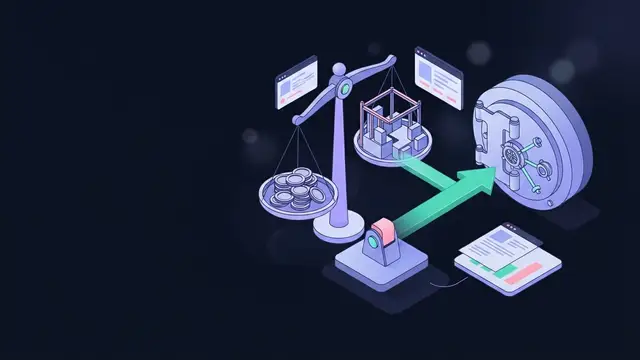
Disguised Unemployment Explained: Key Types and Economic Impact
By Markets & Investing DeskUpdated Nov 10, 2026

Definition
Disguised unemployment occurs when people appear employed but add little or nothing to total output, so production would stay about the same if they stopped working.
Key takeaways
- Disguised unemployment is employment with near-zero productive contribution: removing the worker would not reduce aggregate output.
- It is most common where a labor surplus meets low-productivity sectors such as family farming and informal trade.
- In a broader sense, hidden unemployment also covers underemployed workers, people kept out of work by illness or partial disability, and discouraged workers. None of them appear in the headline unemployment rate.
Disguised unemployment is a situation in which people appear employed but contribute little or nothing to total output. If they left their work, production would stay about the same. Economists describe this as labor with a marginal product close to zero. These workers are counted as employed, so official unemployment rates do not show them, which is why the term is often used interchangeably with hidden unemployment.
The idea is most often linked to developing economies with large labor surpluses. In those economies, agriculture and informal work absorb more people than the activity actually needs.
How disguised unemployment works
The core mechanism is diminishing returns to labor on a fixed amount of land or capital. Every additional worker adds less output than the one before. Eventually an extra worker adds nothing, because the existing workforce can already handle all the work available.
Hypothetical example: a family farm
A family farms a plot that needs four people to plant, tend and harvest. Seven family members work on it because they have no other job prospects.
| Workers on the plot | Total harvest (hypothetical, bags) | Added by the last worker |
|---|---|---|
| 4 | 100 | n/a |
| 5 | 100 | 0 |
| 6 | 100 | 0 |
| 7 | 100 | 0 |
All seven appear to be employed, and each puts in hours. Yet three of them could move to a factory, a workshop or a service job without any drop in the harvest. Those three are disguisedly unemployed.
An urban version works the same way: a small shop that needs one assistant but employs three relatives who split the shifts, or a crowded street market where many vendors divide a fixed pool of customers. Each person counts as working, but total sales would not fall if some of them left.
This connects to the economist W. Arthur Lewis’s dual-sector model from the 1950s. In that model, surplus rural labor with near-zero marginal productivity could shift into the industrial sector without any loss of farm output, and the model treated that shift as a source of growth.
Types of hidden unemployment
The strict definition covers zero-productivity employment. In everyday use, the term stretches to any group whose capacity to work goes unused and is not captured by the unemployment count.
Underemployment
Underemployment means working in some capacity but below full capacity. It takes two common forms:
- Skill-related. Someone works below their qualifications, such as an MBA graduate who takes a full-time cashier job after failing to find work in their field.
- Time-related. Someone works part time but wants full-time hours and could work them.
Illness and partial disability
Some people who are ill or partially disabled are not working but could be productive in suitable roles. When the cause is illness, this form is usually temporary. People receiving disability assistance are generally classified outside the labor force, so they do not show up in unemployment statistics.
Discouraged workers
Many countries count someone as unemployed only if they are actively seeking work. A person who stops searching after a long, demoralizing hunt therefore leaves the unemployment count, even though they still want a job. They are counted again only when they resume looking.
Disguised vs. open, underemployment and seasonal unemployment
Open unemployment is visible. The person has no job, is looking for one, and is counted in the unemployment rate. Disguised unemployment is invisible in that count because the person holds a job or sits outside the labor force.
Underemployment overlaps with disguised unemployment, and many sources group both under hidden unemployment. The narrow economic definition, however, refers to zero marginal productivity:
- An underemployed engineer driving a taxi still produces output, just less valuable output than they could.
- A disguisedly unemployed farm worker in the strict sense adds nothing to output.
Seasonal unemployment comes and goes with the calendar. Farm laborers out of work between harvests are one example, and resort staff in the off-season are another. Disguised unemployment can last all year: the extra family members on the plot are present in every season, just not needed.
Why it matters
Hidden unemployment represents wasted labor, one of the core factors of production. When surplus workers stay in low-productivity roles, an economy produces less than it could, and its GDP understates its potential. Each surplus worker also carries an opportunity cost: the output they would generate in a job that actually needs them.
The concept also shapes policy. A low headline unemployment rate can coexist with widespread idle or misused labor, so a government that reads only that figure might conclude the labor market is tight when it is not. Common responses aim to create jobs outside agriculture and informal work:
- Rural industry and infrastructure projects.
- Training that matches skills to available jobs.
- Labor market reforms that help employers recognize workers’ skills.
Limitations of the concept
Disguised unemployment is hard to measure directly. Marginal productivity cannot be observed in a survey, so estimates rely on assumptions about how much labor a task truly requires.
Critics of the zero-marginal-product idea point out that farm labor needs change sharply between planting, harvest and the slack months. Workers who look surplus in one season may be essential in another, which blurs the line with seasonal unemployment.
The broader categories are easier to track. In the United States, for example, the Bureau of Labor Statistics’ U-6 measure adds discouraged workers, other marginally attached workers and people working part time for economic reasons to the standard unemployment count. Even so, skill-related underemployment and workers held back by illness remain hard to capture in any single number.
The Bottom Line
Disguised unemployment matters most to policymakers and analysts in developing economies, where family farms and informal trade absorb surplus labor that official unemployment rates miss. A low headline rate can hide idle or misused workers, so it can make a labor market look tighter than it is. Broader measures such as U-6 capture part of this gap, while true zero-productivity work still has to be estimated from assumptions.