What Is the Bandwagon Effect? Why People Follow the Crowd
By Markets & Investing DeskUpdated Nov 10, 2026

Definition
The bandwagon effect is the tendency to adopt a belief, buy a product or make an investment mainly because many others appear to be doing so.
Key takeaways
- Harvey Leibenstein formalized the bandwagon effect in a 1950 paper on consumer demand.
- A bandwagon effect makes the market demand curve flatter, so price changes move quantity more than usual.
- In an information cascade, later people ignore their own private information and copy earlier choices.
- When a crowded trade unwinds, late joiners are most exposed because likely buyers have already bought.
The bandwagon effect is the tendency of people to adopt a belief, buy a product, back a candidate or make an investment mainly because many others appear to be doing so, sometimes overriding their own judgment or information. The more popular a choice seems, the more attractive it becomes. In behavioral economics the bandwagon effect is a cognitive bias. In consumer theory it is a specific demand effect: one person’s demand for a good rises as other people’s demand for it rises.
What the Bandwagon Effect Means
The phrase comes from American politics. A bandwagon carried the band in a parade. In the 1848 presidential campaign, the circus entertainer Dan Rice used his at events supporting Zachary Taylor and invited the crowd to “jump on the bandwagon.” Taylor won, and the expression spread to politicians and voters joining a rising campaign. By the early 20th century it had taken on a critical tone: joining the majority even when that meant setting aside your own principles.
Everyday names for the same tendency are herd mentality and bandwagon bias. The related ideas of social proof and conformity are covered below.
Why the Bandwagon Effect Happens
Social belonging and the winning side
Humans are social, and acting like the group brings acceptance. People also like to be associated with winners and to signal which group they belong to. Once a behavior is common in your circle, seeing it constantly makes it feel normal, and normal choices feel safe.
Heuristics: popularity as a shortcut
The brain relies on heuristics, quick rules of thumb that save time and effort. “If many people chose it, it’s probably good” is one of them. This can be economically rational. Gathering information has a cost, and relying on what others chose lets you skip part of that cost.
Hypothetical example: a new parent could spend hours comparing strollers, or simply buy the model that most friends use. If that model is good, the shortcut saved hours of research. The shortcut fails when the crowd’s choice rests on weak information, when the crowd’s needs differ from yours, or when everyone is copying everyone else and nobody did the original research.
That last failure is what economists call an information cascade. Each person reasonably gives weight to the choices of those before them, but after a few early decisions, later people stop using their own private information at all. The crowd can then look confident while resting on very little evidence.
The illusory truth effect
Repetition alone makes a claim feel truer. Psychologists call this the illusory truth effect, and it is one reason advertising, propaganda and false news can work: the same message, seen again and again, gains credibility without gaining evidence. It feeds the bandwagon effect because a widely repeated view looks both popular and correct.
Bandwagon propaganda
Persuaders use this deliberately. The bandwagon technique in propaganda and advertising tells the audience that “everyone” is already on board: “the fastest-growing brand,” “millions of customers can’t be wrong,” “join the movement.” Bandwagon language works by making non-participation feel like being left behind, rather than by giving reasons to participate.
The Bandwagon Effect in Economics: Demand and Supply
Economist Harvey Leibenstein formalized the idea in a 1950 paper on consumer demand that separated three “external” effects on demand: the bandwagon effect, the snob effect and the Veblen effect. Standard demand theory assumes each consumer’s demand depends only on their own preferences, income and the price. Leibenstein’s bandwagon effect relaxes that: a consumer’s demand also depends on how many other people are buying.
The consequence shows up when the price changes. A lower price draws in new buyers for the usual reason, and those new buyers then draw in more buyers because the good is now more popular. The market demand curve becomes flatter (more price-elastic) than it would be without the bandwagon effect.
Hypothetical worked example. Suppose a gadget sells for $50 and 1,000 units a month are sold.
| Step | Without bandwagon effect | With bandwagon effect |
|---|---|---|
| Price cut from $50 to $40 | Quantity rises to 1,200 (price effect only) | Quantity first rises to 1,200 (price effect) |
| Reaction to the larger user base | None | Extra adoption takes total to 1,500 |
| Total change in quantity | +200 units | +500 units |
The 200 units are the ordinary price effect. The additional 300 are the bandwagon component: people who buy because the visible user base grew. The same logic works in reverse. A price increase that drives some buyers away makes the product look less popular and can trigger a larger drop in demand than the price change alone would explain.
For sellers, this creates a reason to chase market share early, through launch discounts or heavy promotion, since visible adoption itself sells the product.
Where the Bandwagon Effect Shows Up
Politics and polling
Voters may back the candidate who appears to be ahead because they want to be part of the majority. This is why the bandwagon effect is a familiar concern in polling: published polls showing one side leading could, in principle, shift undecided voters toward that side, making the poll partly self-fulfilling. The opposite tendency, the underdog effect, builds sympathy or mobilization for the trailing side. Which one dominates in a given election is an empirical question.
In international relations, realist theory uses bandwagoning for a weaker state aligning with a stronger or rising power instead of balancing against it through a coalition. The word is shared, but the motive is security, not social approval.
Consumer behavior
People buy the phone, sneakers or gadget that “everyone” has, sometimes regardless of whether they need it, can afford it or even want it. Restaurants with a line outside attract more people than empty ones next door, and travel destinations can surge in popularity because they appear everywhere on social media. A related pattern is conspicuous consumption, where expensive goods are bought partly to signal status.
Investing and financial markets
Markets are especially exposed because the bandwagon has a price attached. When more investors buy an asset, its price rises, and the rising price looks like evidence that buying was right. That attracts more buyers. George Soros described this two-way relationship between market participants’ beliefs and prices as reflexivity: perceptions move prices, and prices then reshape perceptions.
Two well-known episodes:
- The dotcom bubble (late 1990s). Many internet startups with no viable business plan, no product ready for market, or little beyond a “.com” name raised large sums of investor money, in large part because the sector was where the money was going.
- The housing bubble and the 2007 to 2009 financial crisis. Lenders, investors and buyers piled into subprime mortgages and real estate on the shared belief that housing prices would keep holding up, a belief reinforced by the fact that everyone else held it. When that belief failed, the result was the Great Recession.
The common driver in individual decisions is fear of missing out (FOMO): buying because others are profiting and you don’t want to be left behind, instead of evaluating the investment on its own merits.
If the Whole Crowd Tries to Exit, Who Is the Buyer?
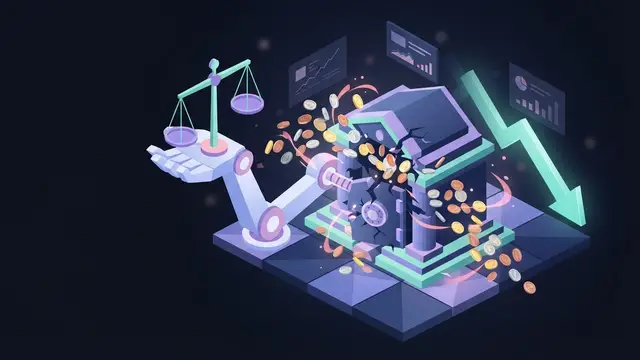
Every trade needs a buyer and a seller. When a crowd that bought together tries to sell together, sellers vastly outnumber buyers at the current price, so the price falls until someone is willing to buy: value investors, short sellers closing positions, market makers, or institutions that consider the asset cheap. That level can be far below where the crowd bought, and falling prices look like proof that selling is right, which brings in more sellers. This is why a crowded trade can unwind much faster than it was built. Late joiners are the most exposed, because the buyers who would have to absorb their shares have already bought.
Is the Bandwagon Effect Good or Bad?
The effect itself is neutral; the outcome depends on what the crowd is doing and whether the crowd is right.
- Positive: if your friends and coworkers save for retirement and talk about it, you are more likely to start saving. Public health campaigns, recycling and seatbelt use can all spread partly through the same mechanism.
- Negative: if everyone around you spends lavishly, matching them when you can’t afford it creates debt. In markets, crowd behavior can inflate bubbles and deepen crashes.
Bandwagon Effect vs. Related Terms
| Term | What it means | How it differs from the bandwagon effect |
|---|---|---|
| Herd behavior | Individuals in a group acting collectively without central direction | Largely a synonym; “herding” is the more common term in finance research |
| Social proof | Using others’ actions as evidence of the correct behavior, especially under uncertainty | The informational mechanism behind much bandwagon behavior |
| Conformity | Changing behavior or stated beliefs to match a group, often due to social pressure | Conformity can happen without the choice being popular in society at large; the bandwagon effect is tied to perceived majority or momentum |
| Groupthink | A cohesive group suppressing dissent to reach consensus | Describes decision-making inside a team; the bandwagon effect describes individuals following a wider crowd |
| FOMO | Anxiety about missing gains or experiences others are getting | An emotional driver that often pushes people onto a bandwagon |
| Snob effect | Demand falls as more people buy a good, because exclusivity is lost | The opposite of the bandwagon effect in Leibenstein’s framework |
| Veblen effect | Demand rises with the price itself, because a higher price signals status | Driven by price, not by the number of buyers |
| Contrarian investing | Deliberately taking positions against prevailing sentiment | A strategy that tries to exploit bandwagon-driven mispricing |
“Trend-hopping” is an informal near-synonym, usually applied to fashion or social media trends. The related logical fallacy is the appeal to popularity (argumentum ad populum), which treats “many people believe it” as proof that it’s true.
Limitations of the Concept
The bandwagon effect explains a mechanism, not a frequency. Knowing that people can follow crowds does not tell you how strong the effect is in a given market, election or product launch, or whether it will outweigh opposing forces such as the snob or underdog effect.
It is also hard to separate from good information. If many people buy a product because it is genuinely good, popularity and quality move together, and calling the result a “bandwagon” adds little. The effect is clearest when popularity keeps rising after the underlying merits stop justifying it, and that is usually easier to identify in hindsight than in real time. Finally, the label can be misused to dismiss any majority view; a popular position can still be correct.
How to Reduce the Bandwagon Effect in Your Own Decisions
- Think critically about your own situation. Ask how your needs, budget, time horizon or risk tolerance differ from those of the people around you, and use a contrarian view to test the popular option.
- Use reliable sources. Prefer information that has been checked from several directions, discloses its biases, and doesn’t profit from the choice you make.
- Slow down. Step away from outside input before deciding, and treat pressure for an immediate decision, especially “everyone is buying now,” as a reason to wait.
- For investments, write down the reason before you buy. If the only reason is that the price has been rising and others are buying, you have described momentum, not value.
The Bottom Line
The bandwagon effect matters most to investors and shoppers facing popular choices, where rising prices or visible adoption can pass for evidence. The effect itself is neutral, since a crowd can be right, but it is hard to spot in real time. Before buying, write down a reason that goes beyond rising prices and other people buying, and treat pressure to act immediately as a signal to wait.