Which European Countries Don't Use the Euro?
By Personal Finance DeskUpdated Nov 10, 2026
Key takeaways
- Denmark is the only EU member with a formal opt-out, secured after voters rejected Maastricht in 1992.
- Sweden must adopt the euro under EU law but avoids it by never joining ERM II, a required two-year step.
- Poland would need a constitutional amendment backed by two-thirds of the Sejm to replace the złoty.
- Bulgaria left the list on January 1, 2026, swapping the lev for the euro at 1.95583 lev per euro.
| # | Country | Currency | Code | 1 EUR = | 1-year change | Status |
|---|---|---|---|---|---|---|
| 1 |  Czechia | Czech koruna | CZK | 24.4011 | 1.0% | EU |
| 2 |  Denmark | Danish krone | DKK | 7.4752 | — | EU · ERM II |
| 3 |  Hungary | Hungarian forint | HUF | 364.71 | −5.1% | EU |
| 4 |  Poland | Polish złoty | PLN | 4.4045 | 4.2% | EU |
| 5 |  Romania | Romanian leu | RON | 5.3473 | 5.2% | EU |
| 6 |  Sweden | Swedish krona | SEK | 11.1124 | 1.2% | EU |
| 7 |  United Kingdom | Pound sterling | GBP | 0.8342 | −5.4% | Non-EU |
| 8 |  Switzerland | Swiss franc | CHF | 0.9244 | 0.1% | Non-EU |
| 9 |  Liechtenstein | Swiss franc | CHF | 0.9244 | 0.1% | Non-EU |
| 10 |  Norway | Norwegian krone | NOK | 10.5503 | −10.0% | Non-EU |
| 11 |  Iceland | Icelandic króna | ISK | 136.56 | — | Non-EU |
| 12 |  Serbia | Serbian dinar | RSD | 117.49 | 0.2% | Non-EU |
| 13 |  Albania | Albanian lek | ALL | 90.6780 | — | Non-EU |
| 14 |  Bosnia and Herzegovina | Convertible mark | BAM | 1.9558 | 0.0% | Non-EU |
| 15 |  North Macedonia | Macedonian denar | MKD | 61.5303 | −0.1% | Non-EU |
| 16 |  Moldova | Moldovan leu | MDL | 19.9275 | — | Non-EU |
| 17 |  Ukraine | Ukrainian hryvnia | UAH | 50.0897 | 2.6% | Non-EU |
| 18 |  Belarus | Belarusian ruble | BYN | 3.3034 | — | Non-EU |
| 19 |  Russia | Russian ruble | RUB | 91.3069 | — | Non-EU |
| 20 |  Turkey | Turkish lira | TRY | 55.6232 | 13.5% | Non-EU |
| 21 |  Georgia | Georgian lari | GEL | 2.8558 | — | Non-EU |
| 22 |  Armenia | Armenian dram | AMD | 397.36 | — | Non-EU |
| 23 |  Azerbaijan | Azerbaijani manat | AZN | 1.8750 | — | Non-EU |
ECB-based daily reference rates · 2026-11-14
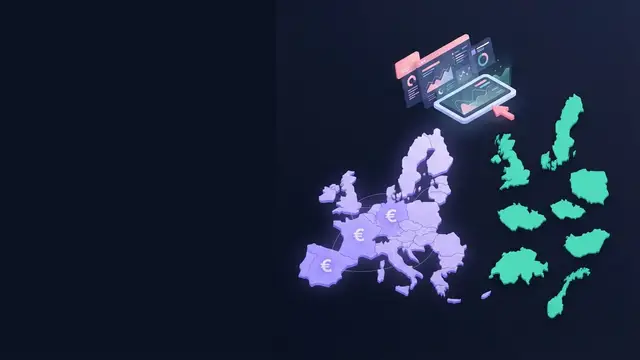
Six European Union member states don’t use the euro: Czechia, Denmark, Hungary, Poland, Romania and Sweden. The other 21 EU members share the euro. Outside the EU, most European countries also keep their own money, from the pound sterling and the Swiss franc to the Turkish lira and the Ukrainian hryvnia. Older lists often say seven EU countries stay out. That count included Bulgaria, which replaced the lev with the euro on January 1, 2026, at a fixed 1.95583 lev per euro after more than five years in ERM II, becoming the eurozone’s 21st member.
The six EU holdouts are not in the same position. Denmark has a legal right to stay out. Sweden is legally bound to join but has avoided the final step. Czechia, Hungary, Poland and Romania are also obligated but have set no firm date.
How the list is ordered
The list is grouped by EU status. The six EU members come first, in alphabetical order. The non-EU countries follow roughly by region: the United Kingdom and the Western European countries outside the bloc, then the Western Balkans, then Eastern Europe, Turkey and the South Caucasus. The order is not a score, and a country higher up is not more stable or more important. EU members other than Denmark must eventually adopt the euro; non-EU countries have no obligation toward it.
The six EU members outside the eurozone
Denmark: a legal opt-out and a fixed link
Denmark is the only current EU member with a formal exemption. Danish voters rejected the Maastricht Treaty in 1992, and the country then negotiated a protocol that lets it stay out of the single currency. In a 2000 referendum, Danes voted against adopting the euro.
The krone is still closely tied to the euro. Denmark has been in ERM II since the euro’s launch in 1999, with a central rate of 7.46038 kroner per euro and a permitted band of plus or minus 2.25%. In practice, Danmarks Nationalbank keeps the krone much closer to that central rate than the band allows. Denmark keeps its own notes, coins and central bank, but it gives up most independent interest rate policy, because rates have to support the peg.
Sweden: obliged to join, but not taking the step
Sweden joined the EU in 1995 without an opt-out. Under EU law it must adopt the euro once it meets the entry criteria. One of those criteria is two years of participation in ERM II, and by never joining the mechanism Sweden stays out of the euro.
Swedish voters rejected the euro in a 2003 referendum, with about 56% voting no. Successive governments have treated that result as binding, and the krona continues to float.
Poland, Czechia, Hungary and Romania: obligated with no fixed date
Poland, Czechia and Hungary joined the EU in 2004, and Romania in 2007. Each accession treaty commits the country to adopting the euro eventually, but none sets a deadline. Each government has postponed the switch, and none of these currencies is in ERM II.
Poland has an extra hurdle. Its constitution gives the National Bank of Poland the exclusive right to issue the currency and set monetary policy. Adopting the euro would therefore require a constitutional amendment, which needs a two-thirds majority in the Sejm, the lower house of parliament. Polish governments have argued that the economy is better served by keeping the złoty and rate-setting at home, often citing the 2008 to 2009 financial crisis, when Poland avoided recession while its currency weakened.
Czechia, Hungary and Romania have also kept national currencies while their governments weighed timing, public opinion and how ready their economies are. Romania has repeatedly struggled with the budget deficit test described below.
What it takes to adopt the euro
EU members other than Denmark must join the euro once they meet the convergence criteria set out in the Maastricht Treaty:
- Price stability: inflation no more than 1.5 percentage points above the average of the three best-performing EU members.
- Public finances: a government deficit below 3% of GDP and government debt below 60% of GDP, or falling toward it at a satisfactory pace.
- Long-term interest rates: no more than 2 percentage points above the average of the same three best performers on inflation.
- Exchange rate stability: at least two years in ERM II without severe tensions or a devaluation against the euro.
- Legal compatibility: national law, including the central bank’s statute, must be compatible with membership of the Eurosystem.
The European Commission and the European Central Bank publish convergence reports assessing each candidate. Two of the criteria are effectively under national control: a country decides when to apply to ERM II, and it can keep its central bank law unchanged. Either choice lets a government delay adoption indefinitely without formally refusing it.
Why some countries keep their own currency
The ECB, based in Frankfurt, sets one monetary policy for every euro member. Countries that stay out keep several tools the eurozone members gave up.
Interest rates set for local conditions. A single policy rate has to fit economies with very different inflation, growth and household debt, and where many mortgages carry variable rates, an ECB rate change hits households quickly whether or not it suits the local economy. During the 2008 crisis, the Bank of England began cutting rates in October 2008 and started buying assets in March 2009. The ECB did not launch large-scale government bond purchases until 2015.
Inflation control. Raising rates is the standard tool against rising inflation, and a national central bank can use it as soon as it sees fit. Inside the eurozone, a rate decision follows conditions across the whole area. In 2011 the ECB raised rates twice, and critics argued the hikes reflected price pressure in stronger economies such as Germany while hurting Italy, Greece and others in the middle of the debt crisis.
A lender of last resort for government debt. A country with its own central bank can have it buy government bonds when yields spike, capping borrowing costs. Eurozone governments borrow in a currency they do not issue. The ECB’s programs that can buy specific members’ bonds, the Outright Monetary Transactions program in 2012 and the Transmission Protection Instrument in 2022, come with conditions and are decided centrally, not by the country under pressure.
Exchange rate adjustment. A floating currency can weaken when an economy loses competitiveness, making exports cheaper abroad and attracting foreign investment, though it also raises the cost of imports and of debt owed in foreign currencies. A eurozone member cannot do this alone, because the euro’s value is shared by 21 countries.
The trade-off runs the other way too. Euro members avoid exchange rate costs and currency swings with their main trading partners, get easier access to a large single market, and have prices that can be compared directly across borders. For Bulgaria, whose currency was already pegged to the euro, joining meant giving up little policy freedom it actually used while gaining a seat at the ECB.
Non-EU Europe: own currencies and euro ties
Most European countries outside the EU issue their own currency. The United Kingdom kept the pound while it was an EU member, through its own opt-out, and left the EU in 2020. Norway, Iceland and Switzerland never joined the EU. Norway and Iceland take part in the single market through the European Economic Area, and Switzerland through bilateral agreements, without any obligation to adopt the euro. Liechtenstein has no currency of its own and uses the Swiss franc under a currency treaty with Switzerland.
Currencies tied to the euro
Some non-EU currencies are pegged to the euro, so their rate barely moves. Bosnia and Herzegovina’s convertible mark was originally pegged to the Deutsche mark and now trades at a fixed 1.95583 per euro under a currency board. North Macedonia’s central bank keeps the denar effectively pegged to the euro.
Euro users that are not on the list
Several European places use the euro without being EU members, so they do not appear in a list of countries without it. Monaco, San Marino and Vatican City use the euro under formal agreements with the EU, and Andorra has a monetary agreement as well. Montenegro and Kosovo adopted the euro unilaterally and have no seat at the ECB.
Reading the exchange rate columns
“1 EUR =” shows how many units of the local currency one euro buys, based on ECB reference rates. A large number reflects how the currency is denominated, not weakness. The Hungarian forint and Armenian dram trade at hundreds per euro, and the pound at less than one, but neither figure measures economic strength.
Change (%) = (current units per euro − earlier units per euro) ÷ earlier units per euro × 100
In a hypothetical example, a move from 100 to 110 per euro is a 10% rise. Each euro buys more local currency, so the local currency lost value against the euro, by about 9.1% (100 ÷ 110 = 0.909). For a traveler converting euros, a rise means more local money per euro. For a company in that country paying euro-priced bills, it means higher costs. A large move in either direction signals a floating currency.
FAQs
Can you pay with euros in countries that don't use them?
Not as a right. In Czechia, Denmark, Hungary, Poland, Romania and Sweden, the national currency is the only legal tender. Shops, hotels or airports may choose to accept euros, usually at their own exchange rate, but they are not required to. Paying in the local currency, or by card in that currency, avoids the merchant's conversion markup.
The Bottom Line
Travelers, investors and businesses dealing with Czechia, Denmark, Hungary, Poland, Romania or Sweden still face national currencies and exchange rate costs. Denmark's krone moves very little against the euro, while floating currencies like the krona can swing widely. Every holdout except Denmark is legally bound to join, yet staying out of ERM II or keeping central bank law unchanged lets governments delay adoption indefinitely.